
'Sockpuppet' usually means a fake online identity controlled by one person to mislead, manipulate, or conceal who is really behind an account. For threat-intelligence and trust-and-safety analysts, the term matters because in scam investigations, sockpuppets let one actor appear as many people, roles, or businesses across channels. This article explains the meaning, how sockpuppets show up in scam operations, what evidence helps connect them, and where the term overlaps with account linkage and indicator correlation. For related collection and output context, see the Active Defense home page, scam indicator feeds, and what stays after message deletion.
What 'sockpuppet' means in scam work
A sockpuppet is a fake online persona controlled by a real operator and presented as if it were an independent person. For analysts, the key point is not just that the identity is false. It is that the account is used to shape trust, steer decisions, or hide who is actually behind the conversation.
That makes a sockpuppet narrower than a generic fake account and more purposeful than a simple alias. An alias can conceal a name. A sockpuppet is built to perform a role. In scam investigations, that role may be:
- a buyer or seller
- support staff
- a payment contact
- a recruiter
- an investor
- a romantic interest
- a supposed third-party confirmer
The operator may use that role to move a target toward a payment step, including a mule account, a gift-card route such as Paysafecard payment, or a wallet discussed in crypto wallet analysis.
The term is useful because it gives teams a precise way to talk about deceptive identity control. It also explains why one visible account should not be treated as one actor, one victim journey, or one scam stage.
In intelligence work, the label matters less than what the persona exposes. Once a sockpuppet starts talking, it can hand over operational details that belong in scam indicator feeds and structured output such as STIX 2.1. For examples from live collection, see the weekly scam briefings and monthly scam data reports.
How sockpuppets show up in online scam investigations

Sockpuppets appear across many scam types. Analysts see them in marketplace fraud, investment scams, impersonation scams, romance scams, advance-fee fraud, and fake support or recovery approaches. In each case, the fake identity helps the operator control how the target reads the next message, payment request, or handoff.
A single operator may play several parts inside one fraud flow. One account starts the contact. Another account "confirms" the story. A third pushes payment or urgency. A fourth appears as a satisfied customer or neutral verifier. What looks like several independent people can be one actor, or a small group sharing access to a set of personas.
Sockpuppets also create false consensus. In chats, channels, and comment threads, they can make a scheme look active, trusted, or widely used. Multiple short replies, endorsements, or testimonials can give the impression that other people have already checked the offer and found it safe.
Cross-channel movement is another practical clue. The same narrative may appear first by e-mail and then continue on Telegram under a different name and profile photo. The visible identity changes, but the storyline, payment instructions, and contact pattern often stay close enough to compare.
Personas also rotate for simple operational reasons. Accounts get reported, burned, locked, or abandoned. When that happens, scammers switch names, photos, and surface branding, while the underlying payment rails and contact methods recur.
That is why forwarded accounts, reused photos, repeated payment instructions, and recurring contact details usually matter more than display names alone. Profile text and branding are cheap to change.
For investigators, the useful clues are often inside the conversation itself. Each message may add operational evidence: a wallet, bank detail, phone number, e-mail address, payment handle, file, photo, or another contact point that helps connect the persona to a wider scam operation.
What evidence helps analysts connect sockpuppets to one actor
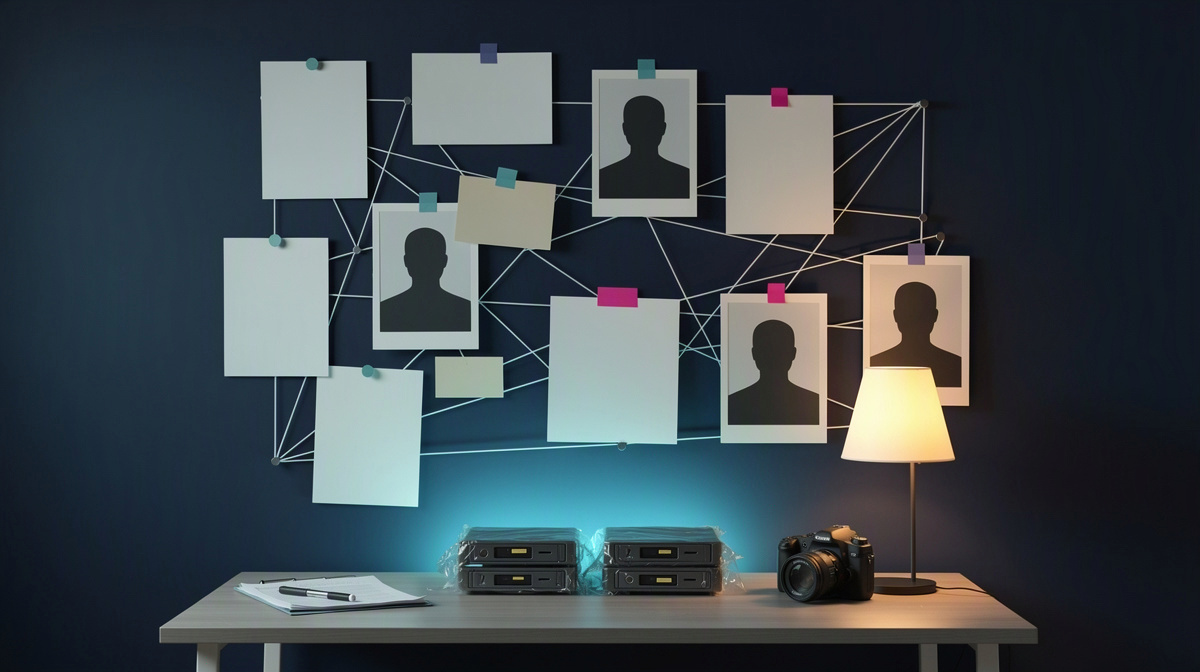
The strongest linkage evidence is usually operational reuse, not surface similarity. Names, bios, and profile styling change fast. What tends to persist is the infrastructure a persona uses to get paid, continue contact, or move the conversation forward.
Useful evidence includes:
- crypto wallets
- bank details
- phone numbers
- e-mail addresses
- messenger accounts
- URLs
- gift cards
- payment handles
- file hashes
- photo hashes
These indicators are more useful when they recur across separate chats or channels. One hit may be weak on its own. Several repeated indicators, or one repeated indicator plus reused media, can support a much stronger linkage judgment.
Media reuse is often overlooked. The same photo may return under a new name, or the same document image may appear in a different role. Photo hashing helps spot exact matches, while perceptual hashing helps catch near-matches after cropping, compression, or small edits. Attachment hashes serve a similar purpose for files that reappear across conversations.
Message preservation matters because scammers edit their trail after the fact. A deleted payment instruction, forwarded contact, or attachment can still be important if the content was captured when it arrived. That preserves the evidence needed to compare later chats with earlier ones.
In Active Defense, every message is stored the moment it arrives. From each message, the system extracts crypto wallets, bank details, phone numbers, messenger accounts, links, gift cards, payment handles, and file and photo hashes, each with a confidence score. Chats that share an indicator, a reused photo, or a forwarded account are linked to one actor. That turns raw chat data into structured output that fits cyber intelligence feeds.
The practical standard is cumulative evidence. Treat indicators as scored signals, then weigh recurrence, context, and combinations. That approach is more useful than trying to prove control from one screenshot, one phrase, or one account name.
How to use sockpuppet findings in a threat-intelligence workflow
A useful workflow output is not just a list of fake profiles. It is a structured record of the indicators those profiles exposed and the relationships between them. That means capturing the wallets, bank details, phone numbers, e-mail addresses, messenger accounts, URLs, gift cards, payment handles, and file or photo hashes that appeared, then preserving how they connect across chats.
For trust-and-safety teams, that structure helps with day-to-day operations. It can support:
- prioritizing reviews
- linking repeat abuse across accounts
- enriching escalations with supporting context
- informing disruption decisions
For threat-intelligence teams, the same material is useful in a different way. Collections of scored indicators can be fed into internal systems, compared over time, and used to map recurring actor behavior. Preserved conversation context also matters because a weak signal today may become useful later when another case reveals the same contact point, payment destination, forwarded account, or reused image.
Relationship data is what turns isolated findings into intelligence. One account may look low-signal on its own. Connected to repeated wallets, recurring contact details, or reused media, it can become much more informative.
In Active Defense, each customer gets their own feed with STIX 2.1 export, rebuildable from stored history. Replies to scammers are drafted by AI and approved by a human operator by default. Console and API run on Azure in Germany.
For teams evaluating collection sources, this is the point where output format and preservation model matter as much as collection volume. A free feed sample is available for qualified leads. There is also a 90-day pilot for up to 500 conversations at 1,900 EUR net, credited to the subscription afterwards.
Questions analysts ask about sockpuppets
Does a sockpuppet have to use a fake name?
No. What makes it a sockpuppet is control and presentation, not just whether the name is invented. An account can use a plausible personal name, a business identity, or a role account and still function as a sockpuppet if one operator uses it to appear independent and shape trust.
Are sockpuppets only a social-media problem?
No. Analysts run into them anywhere a scammer can sustain a persona. In practice, that includes e-mail and messengers such as Telegram. The same operator may present one identity in one channel and a different one in the next while keeping the same objective.
What makes attribution stronger when the persona itself is thin?
Thin personas are common, so the question is usually not profile depth but whether the conversation yields reusable evidence. Attribution gets stronger when multiple low-level signals line up, especially across separate chats. Useful examples include:
- a payment destination
- a contact method
- a forwarded account
- reused media
- the same file turning up again
That kind of overlap is often more helpful than profile wording.
Can deleted or edited chat content still change the analysis?
Yes. A short message that disappears later may still be the piece that explains a handoff or ties two conversations together. In Active Defense, every message is stored the moment it arrives, so a scammer's later "delete for everyone" does not remove the copy. That matters when an actor retracts a wallet, file, photo, or contact after sending it.
What is the practical output from sockpuppet investigation work?
For analysts, the useful result is structured intelligence, not just a note that an account looked fake. Active Defense turns what scammers hand over into a threat-intelligence feed, including crypto wallets, bank details, phone numbers, messenger accounts, links, gift cards, payment handles, and file and photo hashes, each with a confidence score. Chats that share an indicator, a reused photo, or a forwarded account are linked to one actor. Each customer gets their own feed with STIX 2.1 export.
Why the term matters
"Sockpuppet" matters in scam investigations because it moves the analyst's focus away from the account's claimed identity and toward the operator behind it. That shift is useful. A display name, bio, or profile photo can change fast. The harder question is what the account reveals about control, coordination, and repeat behavior.
In practice, the value comes from connection, not labeling. Analysts get more from tying personas together through:
- repeated indicators
- reused photos or files
- forwarded accounts
- preserved conversation data
Used that way, the term becomes more than a description of a fake profile. It becomes a clear investigative concept for discussing how one actor appears as many people. Teams that define it precisely can share findings with less confusion across trust-and-safety, fraud, and threat-intelligence work.